NH558J2
The Dark ForestNH558J2 is a planetary system eighteen light-years from the Solar System, selected as the first destination of Starship Earth. Its importance lies less in its suitability for settlement than in its strategic usefulness: it offers a possible source of nuclear fuel and gives a fleeing human civilization a rational first step into an unknowable future.
Physical Setting and Known Properties
NH558J2 contains two planets, both gaseous worlds resembling Jupiter and therefore unsuitable for human habitation. Their value is instead logistical. They may provide supplemental nuclear fuel, allowing a starship that cannot remain indefinitely dependent on its original reserves to refuel and continue its voyage.
The system is described through the limits of long-distance observation. Humanity can identify broad planetary characteristics, but cannot reliably determine whether a distant world is genuinely hospitable. This uncertainty is decisive: an apparently Earth-like planet in another system might prove uninhabitable, while NH558J2 at least offers two known fuel-bearing worlds.
Selection as Starship Earth’s Destination
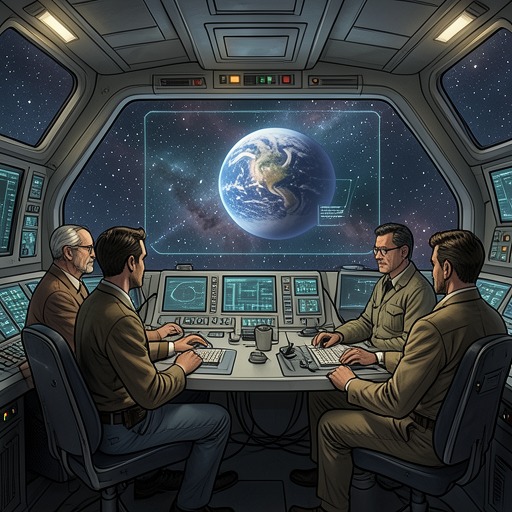
At Starship Earth’s first plenary Citizens’ Assembly, around three thousand citizens attended in person while others participated through a network. The assembly unanimously voted to maintain the heading Zhang Beihai had previously set for Natural Selection, directing the fleet toward Cygnus and, more precisely, NH558J2.
An alternative system lay only 1.5 light-years farther away and was thought to contain a planet with a natural environment similar to Earth’s. Yet that system had only one planet. If the observations proved misleading and the planet was inhospitable, Starship Earth would lose the chance to refuel. NH558J2, with two gaseous planets, represented the safer strategic choice even though it offered no known home for human beings.
The Two-Thousand-Year Voyage
At Starship Earth’s present speed, allowing for the uncertainties of the journey, reaching NH558J2 would take approximately two thousand years. The number transformed the destination from a near-term objective into a civilizational horizon. Most of the citizens who voted for the course would never see the system; even their descendants who arrived there would encounter it only as a way station rather than a final home.
This temporal scale also exposes the fragile continuity implied by the name Starship Earth. The voyage would outlast individual lives, political arrangements, and perhaps the cultural assumptions of the people who began it. NH558J2 could be reached only by a civilization willing to preserve itself through hibernation, succession, and an imagined future that no present participant could personally verify.
Strategic Meaning and Human Settlement
Zhang Beihai’s choice was presented as exceptionally rational because Earth’s habitability was not a coincidence and was unlikely to be reproduced around a distant star. Earth’s livable environment resulted from the long interaction between its biosphere and natural surroundings, a history that could not simply be expected elsewhere. NH558J2 therefore marks the boundary between escape and refuge: it is reachable in principle, useful for survival, but not evidence that humanity will find another Earth.
The possibility remains that no hospitable world will ever be discovered and that the new human civilization will travel forever aboard a starship. That possibility was not made explicit to the present generation, which still needed the sustaining idea of an eventual Earth-like home. NH558J2 thus functions simultaneously as a concrete navigational target and as a quiet challenge to the fantasy of return: the future may consist not of resettlement, but of permanent motion.
Place in the Wider Crisis
NH558J2 belongs to a broader transformation in which the Solar System itself becomes an engineered defensive environment. After the completion of the Tianti Space Elevator and the breakthrough in controlled fusion, humanity expanded exploration of the planets and moons not for pure discovery but to establish bases for defense. The exploration of Mercury and Venus gained strategic importance, and the proposed stellar hydrogen bomb test on Mercury showed how survival planning turned planetary bodies into military instruments.
That transformation carried severe costs. Construction of the space fleet required unprecedented work on spacecraft, weapons, recirculating ecosystems, and spaceports, while the heavy industry supporting the effort intensified pollution, climate anomalies, desertification, and eventually famine. NH558J2 represents the outward extension of the same logic: when Earth becomes politically and ecologically endangered, survival is pursued by converting distant celestial systems into resources.
The destination also stands against the informational transparency imposed by the Sophons. Because the Trisolarans can observe human plans throughout the Solar System, the Wallfacer Project was created to preserve strategic deception as humanity’s remaining advantage. Later, the rise of the space fleet as a suprastate entity showed how defense reorganized political power. NH558J2 is the geographical endpoint of that reorganization, where a military escape route becomes the basis for an independent starship civilization.
Symbolic and Narrative Significance
NH558J2 is neither a promised paradise nor a conventional colony. Its two planets are unsuitable for life, its fuel value is more important than its scenery, and its distance makes arrival a matter for descendants rather than its original travelers. The system gives the voyage direction without giving it closure.
Its significance is sharpened by the contrast between ecological restoration and cosmic escape. On Earth, gravitational-wave emissions later create rainfall around the antenna and turn part of the desert of northern China into a small green oasis, demonstrating that technology can produce local environmental change. Yet such engineered renewal does not restore the lost certainty of Earth as humanity’s sole home. NH558J2 remains the colder alternative: not a repaired world, but a distant station in a civilization learning that survival may require inhabiting uncertainty itself.